

|

|

|

|

|

Surround Delivery Formats For Music
by Bobby Owsinski
This article originally appeared in issue #2 of Surround Professional in January 1999.
While it's all well and good that we are now producing these marvelous surround mixes in the studio, one overwhelming, mind-searing question still remains. How do we deliver them to the consumer? Well there's actually several ways to supply mulitchannel music on a disc at the moment, another coming any minute, and yet another about to be born. Let's take a look at our alternatives.
SOME BACKGROUND FIRST
All but one of the formats that we'll be discussing are in some way based upon the Digital Versatile Disc (and the odd one could change to it soon as well), so some DVD basics are in order. The DVD distinguishes itself from a CD in two ways; storage capacity and file system.
Storage Capacity
While the storage capacity of a current CD is 650MB, the capacity of a DVD can actually be one of four levels, all far exceeding the CD. This is accomplished by having smaller and more pits on the substrate than that of a CD. Add to this the fact that DVD can have two layers and be double sided, and the power of DVD becomes readily apparent. (FIGURE 1 ) Because a laser with a smaller wavelength is required, a DVD cannot be read by a CD player. A CD can be read by a DVD player though.
FIGURE 1 - DVD TYPES AND CAPACITIES

Please Note: There's some unfortunate confusion as to the actual capacity of a DVD because it's measured differently than the computer norm. For example, a DVD-5 has 4.7 billion bytes (G bytes) not 4.7 gigabytes (GB). The problem is that DVD is based on multiples of 1000 while the computer world measures bytes in multiples of 1024. Therefore, a DVD-5 actually has a capacity of 4.38 gigabytes.
File Format
Today's CD can be thought of as essentially a "bit bucket" in that there is no intelligence built into the different file formats required for audio CD, CD-ROM, CD-R, etc. DVD differs in that the various types use basically the same DVD-ROM-like format with a bit of intelligence built into the specification.
DVD uses a file format known as Universal Disc Format or UDF which was designed specifically for use with optical medium and avoids the problems and confusion that CD-ROM's had due to the use of many different file formats. In fact, UDF permits the use of a DVD by DOS, OS/2, Macintosh, Windows and UNIX operating systems as well as dedicated players. What's interesting is that a dedicated DVD player will access only the information that it requires and all other files will remain invisible. It also means that the file system for use with computers is already built into the format, which widens the potential market without having to jump through programming hoops.
CURRENT DELIVERY SYSTEMS
DVD-V
DVD-Video burst upon the scene about a year ago primarily as a high quality movie delivery system, but the audio portion of the format is still quite an improvement over Red Book CD. And because there's automatic provisions for multichannel audio and a built-in (but limited) 96/24 option, DVD-V may yet become a major delivery format for audio before all is said and done.
SONICS
The audio portion of a DVD-V can have up to eight bit streams (audio tracks). These can be 1 to 8 channels of Linear PCM (LPCM), 1 to six channels (5.1) of Dolby Digital, or 1 to eight channels (5.1 or 7.1) of MPEG-2 audio (FIGURE 2). Also, there are provisions for optional DTS or SDDS encoding as well.
The LPCM bit stream, which is the same uncompressed format as today's Red Book CD (which is standardized at 44.1kHz and 16 bit), can use either a 48 or 96kHz sample rate with a bit depth of either 16, 20 or 24 bits. Now on the surface this seems great and makes you wonder why another format for multichannel audio is even considered, but then you realize that the bit rate for the audio data is capped at 6.144Mbps. The bit rate is equivalent to the size of the pipe that the audio data has to flow through and in this case the pipe isn't big enough to fit 6 channels of 96/24 audio. In fact, all you can squeeze through is 2 channels of 96/24. If you want multichannel, you're back at 48k but at least the bit depth is raised to 20 bits for six channels. (See FIGURE 2 ) So now we have to go to some sort of data compression scheme to fit all of the channels down the pipe at a higher audio quality.
FIGURE 2 - AUDIO PORTION OF A DVD-VIDEO
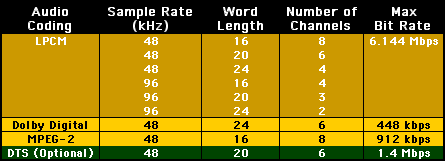
The standard compression scheme for DVD-V is Dolby Digital (or AC-3) which compresses six channels (5.1) of up to 24 bit audio to fit through the DVD-V audio pipe but is limited to only a 48kHz sampling rate. Plus it is a lossy compression algorithm with a maximum bit rate of 448kbps (although 384 is mostly used) which means that data, some potentially useful, is thrown away in the process (although the goal is to only throw away the data that you won't miss). MPEG-2 Audio, which can be configured either six channel (5.1) or eight channel (7.1) at 48/16 , is also an optional compression scheme but hardly used (especially in the US) due to lack of decoders in the marketplace. Even though MPEG-2 does have a higher bit rate at 912kbps, the algorithm has its share of inherent coding problems which effectively negates its lower data compression.
Although an optional coding process, DTS encoding can also prove to be an interesting choice since it can potentially encode up to 8 channels of 96/24 with less data compression than either Dolby Digital or MPEG (see the section on the DTS music disc for more details).
ADVANTAGES
Installed Base Of Players - DVD-V audio can currently play on all DVD players in the marketplace and, with a small bit of additional authoring, all computer DVD-ROM drives as well (providing the PC has the appropriate decoding hardware/software). The latter is a huge consideration since computer manufacturers promise us that 1999 will be the year when the DVD-ROM drive finally replaces the CD-ROM drive in new PC's purchased. Couple that with marketing projections which state that pre-Generation-Xers just love entertainment on their computers, and this format demands consideration as a primary audio delivery system.
Compatibility With The Greatest Number Of Players - Unlike DVD-A (which we'll discuss in a second) which requires a new generation of player, DVD-V audio is universally compatible with existing and future DVD players.
No Confusion In The Marketplace - The average consumer doesn't know DVD-V from DVD-A, much less care. All he knows is that DVD looks good and sounds good. DVD-V audio eliminates any confusion in the marketplace as to which DVD will play on which player.
Available Now - Multichannel music can be delivered right now using the audio portion of the DVD-V using either Dolby Digital or DTS encoding or even LPCM for short programs.
DISADVANTAGES
Not As Flexible As DVD-A - While there are choices for the audio in DVD-V, the format lacks the scalability and super-high quality options of DVD-A. But while professionals and audiophiles should be able to hear the difference between 96/24 and 44.1/16 Red Book audio, will the average consumer? It seems that the ordinary listener can hear the difference between surround and stereo at any bit depth and sample rate however.
96/24 LPCM Available On Only 2 Channels - The highest quality multichannel LPCM audio available is 48kHz at 20 bits for 6 channels. Using a data compression scheme such as Dolby Digital gives you 6 channels of 48/24.
Some Players Can't Handle 96/24 LPCM - Even if 96/24 LPCM is used, some players automatically decimate to 48kHz and truncate to 16 bits, thereby negating some of the benefits of the enhancement. Then the question is, will your player have 6 outputs?
DTS Music Disc
There's some confusion in the marketplace as to exactly what DTS (Digital Theater Systems) is. Is it a company? Is it a technology? Is it for movies? Is it for music? The answer is really Yes to all of the above.
DTS the company was started some five years ago primarily to bring a higher quality audio in surround to motion pictures than what was available at the time. This was done by way of the DTS data compression process, which is a lossy data compression that reduces the data less and with a different method than it's competitor Dolby Digital and is claimed to sound better as a result. This data compressed film audio was then burned to a CD, synced to the film and translated back into analog 5.1 sound in the theater via a decoder. Since putting audio on a disc was already being done by DTS for film sound, the next logical step was to make a CD strictly for commercial distribution of surround sound music. Hence the DTS music disc was born.
The DTS music disc is actually the only multichannel delivery system of the four discussed that isn't based in some way on the DVD spec. In fact, the DTS compressed bit stream is encoded onto what amounts to a CD-ROM. This can then be played back on any CD player, laser disc player, or DVD player that has a digital output and passes the digital bit stream to a DTS decoder that separates the channels back out to 5.1.
In order to promote their technology, DTS has started it's own record company called DTS Entertainment which licenses previously released and new recordings and remixes them in surround.
Sonics
The DTS music disc provides up to 74 minutes of 5.1 audio at a sample rate of 44.1kHz at 20 bits at the relatively high bit rate of 1.4Mbps. As stated before, the big attraction to DTS is because of the fact that the compression algorithm used is a gentle 3 to 1, which many claim makes it sounds better as a result.
The DTS coding technology is potentially much more flexible than what's currently being used on either the music disc or in film sound however. According to a paper given at the 100th AES convention , DTS encoding is capable of 1 to 8 channels multiplexing, sample rates of 8 to 192kHz, 16 to 24 bit word lengths, a variable bit rate lossless coding mode, various downmix algorithms, and a host of other features not implemented on the current DTS music disc. If these features were ever to be used on a larger and more flexible platform such as DVD, then the combination could well prove to be formidable indeed.
ADVANTAGES
Sonic Superiority - Thanks to it's low compression ratio and high bit rate, the DTS encoding system is generally acknowledged to be the best sounding of the current lossy compression systems.
Available Now - A wide library (75 discs in all musical genres already and another 30 about to be released) of DTS music discs can be found right now at just about anywhere that DTS equipped receivers or decoders are sold.
DISADVANTAGES
Requires a Decoder to Operate - Without a DTS decoder, the only output you get is white noise. However many receivers, even the most inexpensive, now come with a DTS decoder built in.
Distribution Limited Due To Non-Compatible Discs - Because of possible consumer confusion with Red Book CD's (the customer puts it in his CD player only to get a white noise output), many of the biggest music retailers have refused to carry the DTS music disc to this point.
No Value Added Information - Because the DTS music disc uses the limited storage capacity of a CD, there's no room (or provision) for additional text, graphic or video material.
ANY TIME NOW
DVD-A
The DVD-Audio disc is almost upon us and there's a lot to like about it. The main feature and difference between DVD-A and it's video cousin is the ability to provide significantly higher audio quality. Just having the ability to do so doesn't necessarily mean that the highest fidelity audio will happen though, because, as you'll see, for better or worse the final decision as to the sonic quality is largely in the hands of the content producer.
Sonics
DVD-A differs from the audio portion of DVD-V in that the audio pipe is a much larger 9.6Mbps compared to DVD-V's 6.144Mbps. Even with the wider audio pipe, six channels of 96/24 LPCM audio still exceeds the allotted bandwidth. Therefore, once again there needs to be some type of compression to increase the playing time.
As a result, MLP (Meridian Lossless Packing) was selected as the standard data compression for DVD-A. MLP, which gives about a 1.85 to 1 compression ratio, is seemingly lossless, meaning that no data is thrown away during the compression process. Dolby Digital and DTS are listed as lossy compression options. Also possible is the use of other coding technologies besides LPCM such as DSD.
Of special note is the fact that DVD-A is also what is known as Extensible. This means that it's relatively open-ended and can utilize any new audio coding technology that becomes popular in the future.
Scalability
One of the neat and possibly confusing traits about DVD-A is what's known as Scalability, which is a 25 cent word for "Lots of options". Audio-wise the list of options is truly extensive. The program producer is able to choose the number of channels (1 to 6), the bit depth (16, 20, 24) and the sample rate (44.1, 48, 88.2, 96, 176.4 or 192kHz). See FIGURE 3 What's more, the producer can also mix and match different sample rates with different bit depths on different channel families. For example, the front three channels (family 1) can be set to 96/24 while the rear (family 2) and sub channels are set to 48/16. This is important for more efficient bit budgeting if additional space for videos or stereo mixes is required.
FIGURE 3 - DVD-A AUDIO SCALABILITY

Encoding
Even with DVD-A's increased storage capacity, there's still not enough room to contain 74 minutes of discrete multichannel Linear PCM (LPCM) program at the high sample rates and bit depths. So the option exists to compress the audio data several ways.
For the high sample rates and bit depths (88.2, 96, 176.4 or 192kHz/24 bit) Meridian Lossless Packing, or MLP, is provided. This method is attractive in that it can almost double the playing time with supposedly no loss in data and therefore audio quality (See FIGURE 4 ). For the lower sample rates and bit depth (48k/20 bit), Dolby Digital (AC-3) and DTS are also provided as options.
FIGURE 4 - APPROXIMATE PLAY TIME FOR A DVD-5

SMART Content
One of the more interesting aspects of DVD-A is a new feature known as SMART (System Managed Audio Resource Technique) Content. SMART Content is an auto downmix provision that lets a consumer with only a stereo system have the multichannel mix automatically downmixed to that format. In other words, the 6 channel 5.1 mix automatically becomes a stereo mix if that's all the channels that exists in the playback system. While on the surface it might seem like a scary thing having that great multichannel mix fold down to stereo, SMART Content actually gives the producer a choice in the way this downmix will take place by allowing the producer to select one of 16 downmix coefficients that get stored along with the audio data. SMART Content has the added byproduct of potentially eliminating the need to include a separate stereo mix on the disc, thereby freeing up space for either higher quality audio or additional data information. While this looks good on paper, it's still too early to tell what this actually sounds like in practice.
Copy Protection
Of primary concern to all the committees and groups working on DVD-A was the inclusion of strong anti-piracy measures and copyright identification. In fact, the encryption and watermarking issues have actually taken the longest to resolve and continue to hold up the release of the standard as we go to press. One point of concern is that the inclusion of watermarking (which identifies the manufacturer, artist and copyright holder by embedding a digital code in the noise floor) not degrade the audio quality in any way, and this is yet to be determined. One problem still to be overcome is the fact that the watermarking signal can be disrupted if the song is sped up, as it frequently is when played on the radio. One thing is for sure, most record companies feel that watermarking is the key to their future survival in this increasingly digital world, and this portion of the spec will be ironclad before everything is finalized.
Value-Added Content
One of the attractive features of DVD-A is the ability to add additional content such as liner notes, music videos and even Web URLs that enable the consumer to access related material on the Internet when played from a computer's DVD-ROM drive. This could prove another immediate advantage since consumers have always complained about the lack of information found on CD's. Couple this with additional artist commentary, discographies promoting back catalog titles, bios, links to websites (and therefore aftermarket sales), and even a place to finally put those videos that MTV never played, and the value-added material could bring the format to life.
Each track (song) has the ability to display up to 20 still images which can run like a slide show in an automatic or manual mode. This can either be a great way to display artist or song information or a lame attempt to add some info that no one wants, depending on how it's implemented. Videos can also be added in the video portion of DVD-A providing that there's sufficient room.
ADVANTAGES
Extensibility - DVD-A is a somewhat open technology in that there are provisions for new innovations beyond LPCM that can be implemented in the future.
Scalability - The program producer chooses the number of channels, bit depth, sample rate, and encoding method.
Value Added Material - Liner notes, album cover artwork, music videos, artist commentary and Internet links can all be included.
Copy Protection - Strong encryption methods will definitely make DVD-A harder to pirate than any previous digital medium. Watermarking supplies easy copyright identification.
DISADVANTAGES
Will the Consumer Accept Another Format? - While nobody argues that this is a potentially powerful format, there are some that have strong doubts as to whether the consumer will buy in wholeheartedly. Will the average Joe Sixpack be able to hear the difference between 96/24 the same way that he hears the difference between stereo and surround? And will he plunk down another $5-600 on yet another piece of entertainment hardware?
Lack of Moving Pictures During the Song - Many in the production community believe this to be a liability, even though up to 20 still pictures per song may be used. However, if material such as liner notes, artist/producer and even engineer bios and commentary are used, this could actually be a nice adjunct. After all, one of the main complaints about CD's was the lack of information relative to what was previously found on LP's. File this under, Too Early To Tell.
Some DVD-A Discs Won't Play In Some Current DVD Players - Since DVD-A was specified well after DVD-V hit the marketplace, DVD-A discs will not play on the first generation of players already out there. Although this will be eventually rectified over time, it means that three types of DVD players will be in the marketplace in the short term; old style DVD-V only players that can't handle the audio portion of a DVD-A, a universal player that will play both, and a DVD-A only player that will not play the video portion of a DVD-V. Will this initial confusion be enough to stifle the format before it gets started?
Watermarking Adds Artifacts To The Audio Signal In Some Cases - While everyone agrees on the need for some type of copy protection and program identification, it is all for naught if the process interferes with the audio quality. There is no clear consensus currently as to the effect of watermarking, with some claiming that the process is clearly audible and others stating that it's virtually transparent. Even though this is an optional process, do you really think that any record company will not use it if it's available, regardless of the sonic inferences?
COMING SOON
SACD
Thanks to the promise of improved sonic performance as well as backwards and forwards compatibility, the Super Audio CD (SACD) is certainly an intriguing prospect in the multichannel delivery wars. With the massive corporate muscles of Sony and Phillips behind this format, SACD could well prove to be quite a formidable challenger in the multichannel sweepstakes.
The SACD is a dual layer disc with one layer dedicated to normal Red Book CD-type audio and the second to a high density layer for a six channel surround mix, a two channel stereo mix, and extra data such as text, graphics or video. What makes this interesting to the record companies is the ability to be both backwards and forwards compatible, meaning that consumers can play an SACD on their current CD player and play a current CD on a SACD player as well.
Sonics
SACD touts an improvement in sonic quality due to the a new twist in a current recording process known as Direct Stream Digital (DSD). DSD uses essentially the same delta sigma oversampling method used in most modern high-quality analog to digital conversion systems where a single bit measures whether a waveform is rising or falling rather than measuring an analog waveform at discrete points in time. In current systems, this one bit is then decimated into LPCM causing a varying amount (depending upon the system) of quantization error and ringing from the necessary brickwall filter. DSD simplifies the recording chain by recording the one bit directly, thereby reducing the unwanted side effects.
Indeed on paper SACD with DSD looks impressive. A sampling rate of 2.8224 MHz yields a frequency response from DC to 100kHz with a dynamic range of 120dB. Most of the quantization error is moved out of the audio bandwidth and the Brickwall Filter which haunts current LPCM systems is removed. To enable a full 74 minutes of multichannel 100/24 recording, Phillips has also developed a lossless coding method called Direct Stream Transfer that gives a 50% data reduction. Yet some critics speculate that DSD is a closed system with little room for improvement in that both the frequency response and dynamic range cannot be improved much beyond the current spec. Others note the fact that no data interfaces, DSP chips and little supporting software exists while their LPCM counterparts abound.
Other Data
As in DVD-A, text, graphics and video can accompany the audio data. However, this will take the form of todays Blue Book "Enhanced CD" which doesn't look to be quite as elegant an implementation as the UDF file format utilized by DVD. In fairness, this area of SACD doesn't seem to have been given as much thought yet as the audio portion of the disc and we may see some new features and execution as the format comes closer to market.
ADVANTAGES
Sonic Performance - Wide bandwidth goes from DC to 100kHz with a 120dB dynamic range. No adverse filter artifacts thanks to elimination of the brick wall filter.
Plays on Current CD Players - With both backwards and forwards compatibility, consumers won't feel forced to buy expensive new hardware or give up their current libraries. Plus, the Red Book layer of the SACD should sound better as well thanks to the fact that Sony's Super Bit Mapping technology is used.
DISADVANTAGES
Yet Another Format - As with DVD-A, will the average consumer be willing to buy another piece of expensive hardware? Will consumers be confused with yet another format choice?
Is The Sonic Performance Really Better - While DSD seems every bit the equal to the current state of LPCM, advances in convertor technology could eventually move LPCM beyond the seemingly closed format of SACD.
Late to Market - SACD might not hit the market until late 1999. Will this be too late, especially if one of the other formats gains a foothold?
New Production Equipment Needed - Because of the DSD technology, new production equipment, from recorders to editors to digital consoles, is required. Given the fact that LPCM equipment abounds world-wide, will the production community balk at the format?
Initially More Expensive - Not only will the production equipment be more expensive (some estimates are as much as 10 times LPCM), but the disc itself will be more expensive to consumers at least at first. This is because SACD is a dual layer disc which have a higher pressing cost because not all replicators are currently set up for it. This cost should decrease over time however.
And the Winner Is..................
Well, none yet. The good thing is there are lots of options to choose from. The bad thing is there are lots of options to choose from. The best feature is that all of them offer multichannel capabilities and better sonic quality than the current Red Book CD. It seems that until one format emerges as the leader, the choices before us will at least keep life interesting.
ACKNOWLEDGEMENTS
The material for this article was collected and adapted from a multitude of sources including:
Materials collected from the DVD Forum Conferences
The DVD FAQ by Jim Taylor
Premastering New Audio Formats by Sonic Solutions
Super Audio CD Technical Proposal by Sony/Philips
DVD-Audio Briefing Paper by the WG-4
A Closer Look At DTS by Malcolm Hawksford
Various manufacturers literature and white papers
Also thanks to David DelGrosso and Rory Kaplan of DTS, Steve Cohen and Don Levy at Sony, John Kellogg at Dolby Labs for their sage wisdom and guidance.

